



Agentic AI for Lead Generation: How Chicago Businesses Are Turning Social Media DMs Into Qualified Pipeline in 2026
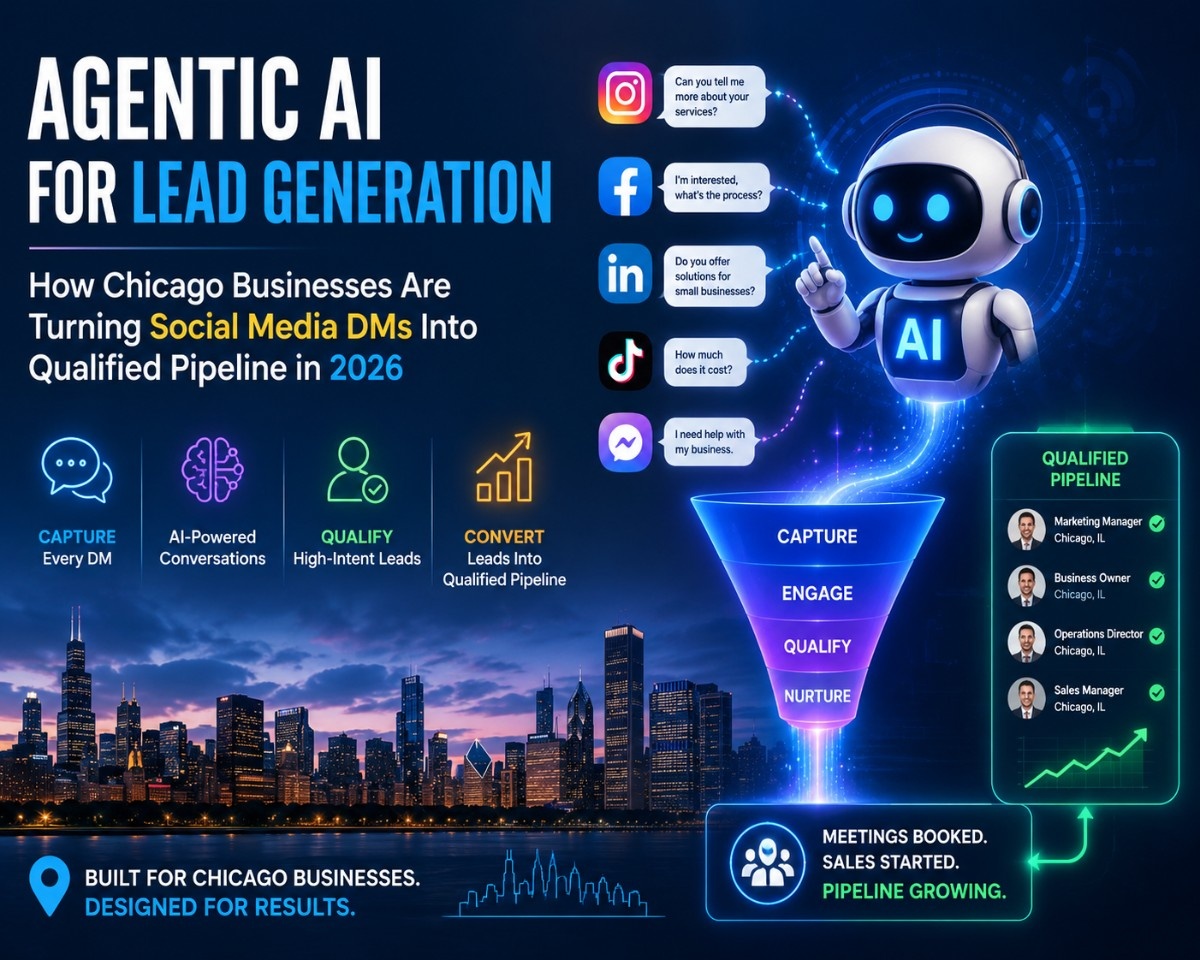
A Lincoln Park real estate agent called us back in March. Her Instagram was on fire. Forty, fifty, sometimes ninety DMs a day. All warm. All buyers. Most going cold before she could pour her second coffee.
She didn't have a marketing problem. She had a response problem. By the time she got to a "Hey, is this still available?" at 10pm, the lead had already DMed three other agents in Bucktown and probably scheduled a showing with one of them.
This is the new shape of AI social media marketing in Chicago in 2026, and most local businesses are losing money on it without realizing.
We've spent the last year building AI lead generation systems for clients across the city, from boutique law firms in the Loop to home services companies out by O'Hare. The pattern is always the same. The leads are already coming in. The funnel is already working. It's the speed and consistency of response that's broken.
Agentic AI is what fixes that. Here's what it is, why it matters, and how the smart Chicago operators are using it to print pipelines.
Why the Social Media Lead Funnel Is Falling Apart in 2026
The old funnel, the one we all learned in 2015, basically doesn't work anymore. Run ads to a landing page, capture an email, drip-nurture for three months, hope for a meeting. That model is leaking everywhere.
A few things broke it at once.
First, buyer behavior shifted. About 2.42 billion people now use generative AI tools monthly, which means a lot of your prospects are asking ChatGPT for vendor recommendations before they ever touch your website. They show up to social media already half-qualified, with a specific question, ready to talk. ALM Corp
Second, speed got brutal. Leads contacted within an hour are seven times more likely to qualify than leads contacted after 24 hours. If your inbox sits unread overnight, you're not slow. You're invisible. Digital Applied Team
Third, the form-fill landing page just isn't where the conversation happens anymore. Social media drives leads for 68% of marketers now, and a real chunk of those leads are sliding into DMs directly, skipping the website entirely. The social media lead funnel has collapsed into the inbox. DesignRush
We had a client in Fulton Market, a B2B SaaS founder, tell us last fall that almost every deal he closed in 2025 started with a LinkedIn DM. Not a webinar. Not a gated whitepaper. A DM. He just couldn't keep up with them.
That's the actual problem. Not awareness. Not traffic. Response. And it's why AI marketing trends in 2026 are pointing hard toward conversation-first lead generation.
What Is Agentic AI?
Quick definition, because the term gets thrown around loosely.
Agentic AI is a system that can take a goal and execute the steps to reach it on its own, without being prompted at every move. You tell it what you want. It figures out how to get there.
Old-school AI worked like a calculator. You typed in a question, it gave you an answer, then it forgot you existed. Earlier AI tools required explicit prompts like "write a subject line" or "generate ad copy." Agentic systems receive strategic objectives instead and then build the entire workflow themselves. Improvado
This is also where conversational AI for businesses has changed shape. The old chatbots that just answered FAQs are gone. What replaced them are agents that can actually carry a conversation across multiple turns, remember context, and make decisions.
For a Chicago business, that means an agent you can task with something like "qualify inbound DMs, book demos with marketing directors at companies with 50 to 500 employees, route everyone else into a nurture sequence." And then it just does it.
It reads the messages. Asks smart follow-up questions. Pulls context from your CRM. Books calendar slots. Flags VIPs for human handoff. Logs everything for your team to review on Monday morning.
That's the difference between a chatbot and an agent. A chatbot answers. An agent acts. And that's what makes agentic AI marketing genuinely different from the AI marketing automation tools most teams have been using for the last five years.
How AI DM Automation Is Replacing Traditional Funnels
We've been telling clients this for about eighteen months, and most of them don't fully believe it until they see the data: the funnel is collapsing into the conversation.
The old steps (awareness, consideration, decision, with seven touchpoints in between) are being squeezed into something much shorter. A prospect sees your content. They DM you. The agent talks to them. They book a call. Sometimes that whole thing happens in eight minutes.
Here's what a real AI DM automation flow looks like for one of our clients, a professional services firm in River North. We changed a few details, but the shape is accurate.
The managing partner posts a LinkedIn carousel on Tuesday morning about a recent compliance ruling. A general counsel at a mid-size manufacturer comments on it, something casual like "saw this hit our team last week too." Within ninety seconds the agent DMs her: "Hey Sarah, noticed your comment on the post. Quick question, are you dealing with this internally or did you bring in outside counsel?"
Sarah replies. The agent asks two more qualifying questions, gets a sense of timeline and budget, and offers two specific time slots for a 20-minute call with the partner. The partner walks into that call already knowing who Sarah is, what her situation is, and what to pitch.
No form fill. No "let me circle back next week." No nurture sequence she would've ignored.
This is AI-powered social selling at its actual working state, and it works because it lines up with how people want to be sold to in 2026. They want to talk where they already are. They want answers in minutes. They want to feel like a person is paying attention, even when the first few messages came from software.
The underlying mechanic here is automated lead qualification. The agent is doing in three messages what an SDR used to take a 30-minute discovery call to do. When AI chatbot marketing is built right, with proper voice training and smart escalation, most prospects don't notice the handoff. What they remember is that someone got back to them fast and got their problem right.
How Chicago Businesses Are Using AI Social Media Marketing
Chicago's a fascinating market for this stuff, and not for the reasons you'd guess.
It's not Silicon Valley. Nobody here is impressed by AI for AI's sake. What people care about is whether the thing pays for itself by Q3. Chicago business owners are operators. They want ROI, not a slide deck about transformative paradigms.
That makes the city a really clean testbed for AI social media marketing. The work either delivers pipeline or it doesn't.
Here's what we're seeing across industries.
Professional services. Law firms and accounting practices in the Loop and West Loop are using LinkedIn DM automation to follow up with people who engage with partner content. Comments on a post are gold. Most firms just let them sit there. An agent turns those comments into qualified conversations within minutes. For B2B lead generation in Chicago, this is the highest-ROI play we've seen this year.
Real estate. From Lincoln Park brokerages to South Loop property managers, agencies are running Instagram DM lead generation systems that handle listing inquiries, schedule showings, and pre-screen tenants. The volume is wild. One client of ours fields over 400 DMs a week now, and the agent handles roughly 80% of them without escalation.
Healthcare and wellness. Multi-location practices (think dental groups, dermatology offices, med spas in Wicker Park and Lakeview) use agents to handle appointment requests, basic insurance questions, and new-patient intake. The trick here is HIPAA compliance, which a lot of off-the-shelf AI marketing automation tools botch.
Home services. HVAC, roofing, plumbing companies serving Chicagoland deal with brutal seasonality. Polar vortex hits in January and the phones explode. AI agents triage by urgency, zip code, and service type, then route emergencies to dispatch within minutes. The capture rate on after-hours inquiries is the metric that moves.
B2B SaaS and tech. Startups out of 1871 and the Fulton Market tech corridor are using AI sales pipeline automation to scale founder-led sales without hiring three SDRs. It's the only way some of them can keep up with inbound while still building product.
The thread that connects all of them: a good AI social media agency in Chicago builds the system, trains it on the brand's actual voice, integrates it with the CRM the team already uses, and tunes it monthly. That's it. The magic isn't the model. It's the deployment. The right Chicago digital marketing agency knows the difference.
What You Actually Get From AI Social Media Management in Chicago
If you're a local business weighing whether AI social media management in Chicago is worth the investment, here's the honest answer to "what does this do for me."
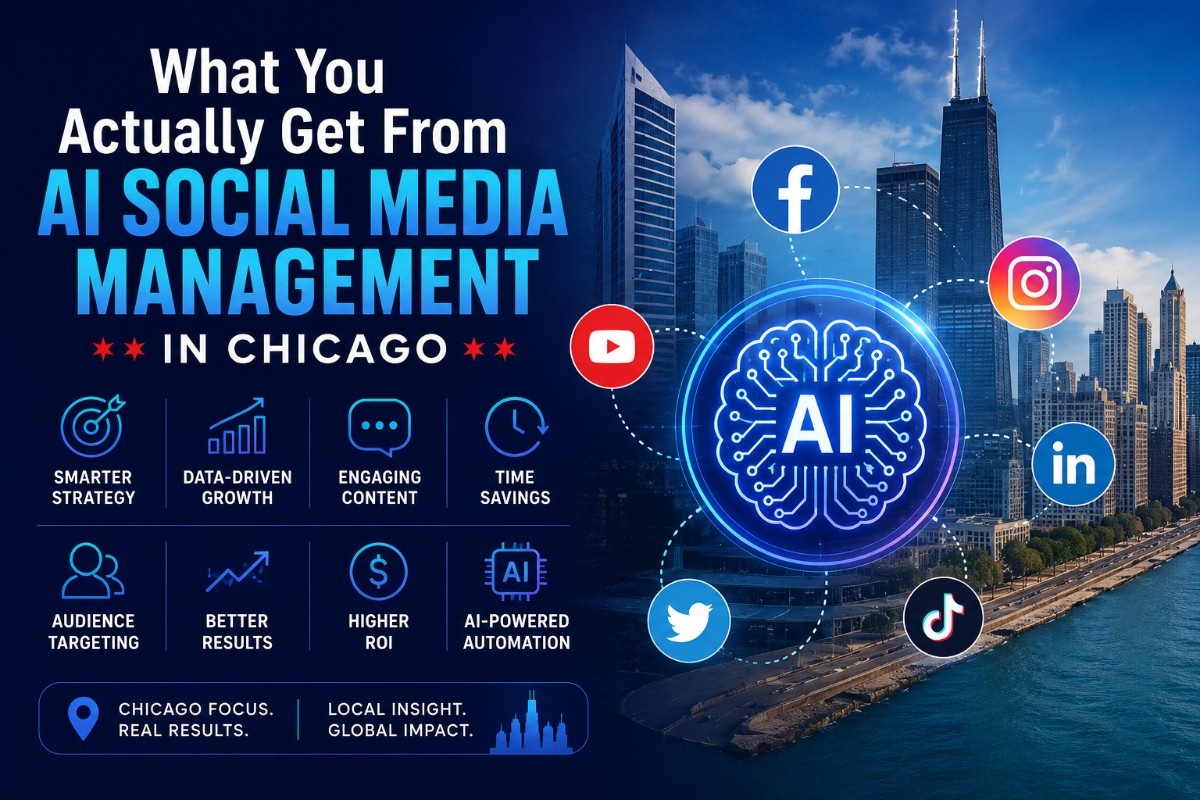
You respond in seconds, not hours. That alone changes your conversion rate more than anything else you could do this quarter.
You're open 24/7. People DM at weird hours. Sunday night is one of the highest-intent windows for B2B inquiries, which makes sense if you think about it. People are planning their week. Your AI doesn't care that it's Sunday.
Every lead gets qualified the same way. No bad days, no rushed responses, no junior team member missing the obvious follow-up question. That consistency is what proper automated lead qualification looks like in practice.
Your salespeople actually sell. They stop chasing cold leads and start closing warm ones, because the only conversations they walk into are the ones already pre-qualified.
You get AI customer engagement data you never had before. Every DM is a logged conversation. After 60 days you'll know which posts drive pipeline, which questions kill deals, and which offers convert. Most teams have never had this visibility.
And the costs go down. Businesses using AI for lead generation report up to 60% lower customer acquisition costs, which makes sense once you do the math. You're not paying a person to do triage work anymore. Martal Group
For local brands competing with national players on paid media, this is the leverage point. You can't outspend the big guys on ads. You can absolutely out-respond them in DMs. That's the real value of AI social media growth services done well.
Three Real Use Cases (Composite, But Accurate)
We can't share specific client names, but these patterns are pulled straight from work we've done in the last year.
The med spa in Lakeview
Two hundred-plus Instagram DMs a week. The front desk couldn't handle it between actual clients walking in. Most pricing questions went unanswered for hours, and the practice was losing first-time bookings to competitors who responded faster.
We built an agent that answered pricing transparently (a big trust signal in the aesthetics industry), asked whether the prospect was a new or returning client, offered a first-visit discount to qualified new leads, and booked directly into their practice management software. Bookings on Instagram DM lead generation went up roughly 3x in the first 90 days.
The SaaS founder in the West Loop
Solo founder running a Series A company, fielding LinkedIn DMs from prospects while also trying to ship product and not lose his mind. Leads were stacking up unread.
We set up an agentic system that monitored his LinkedIn, qualified inbound DMs against his ICP (company size, role, industry vertical), and booked discovery calls with the AE team. Anything VIP, defined as Fortune 1000 inquiries or warm intros from board members, got flagged to him personally. Pipeline coverage from inbound social grew 4x. That's what real AI sales pipeline automation looks like when it's tuned properly.
The home services company in the northwest suburbs
HVAC and plumbing, mostly residential, with a small commercial arm. Seasonal demand kills them. February polar vortex, July heat wave, you know the cycle.
We deployed a Facebook and Instagram DM agent that triaged by service type (emergency vs scheduled), urgency, and zip code, then routed hot leads straight to dispatch. Their after-hours capture rate went from basically zero to around 70%. The owner said the system paid for itself in the first three weeks of February.
None of this is futuristic. It's running right now, while their competitors are still arguing about whether to "try AI."
The Mistakes We See Constantly
We've also seen plenty of AI deployments fail, including some we were brought in to clean up. The failure modes are predictable.
People treat it like a chatbot, not an agent. A scripted bot that says "I'm sorry, I didn't understand that" three times is worse than no bot at all. Worse than a voicemail. Worse than silence.
People skip voice training. If your AI sounds like every other generic AI assistant on the internet, you've already lost. The voice has to be yours. Trained on your sales calls, your founder's posts, the way your team actually talks to customers. This is the single biggest gap between cheap AI marketing automation tools and a properly deployed agentic system.
There's no human escalation logic built in. The AI tries to close a Fortune 500 deal by itself because nobody told it to flag the inquiry for the CEO.
Set-it-and-forget-it deployments. AI agents drift. They need monthly review of conversation logs, copy tightening, qualification logic updates. The teams that win treat this like a living system, not a software install.
CRM integration is an afterthought. Conversations live in DMs, never make it to HubSpot or Salesforce, and the sales team has no idea what's happening in the inbox. Pipeline reporting becomes guesswork.
Compliance gets ignored. Healthcare practices, financial advisors, law firms, all have rules about AI-mediated communication. If you skip this you can get yourself in real trouble.
The brands getting outsized results from AI social media growth services aren't running fancier tech. They're running disciplined deployments.
What Actually Works in 2026 (AI Social Media Marketing Best Practices)
If you're building or auditing a system this year, here's what we'd push you to focus on.
Start with the funnel, not the tool. Map your DM-to-deal journey before you touch any software. Most teams skip this and then wonder why the AI didn't fix the underlying problem, which was usually that the qualifying logic was muddy to begin with.
Train voice obsessively. Pull sales call transcripts. Read your founder's LinkedIn. Listen to how your top closer phrases hard questions. That's your training data. Generic prompts produce generic agents, and generic agents tank your AI customer engagement metrics.
Lead with value, not capture. The DMs that convert aren't the ones that pivot to "let's book a call" by message two. They're the ones that genuinely help. Answer the question. Share the resource. Offer the insight. Trust compounds.
Build for multi-platform from day one. Your agent should be the same brand voice across Instagram, LinkedIn, Facebook, and increasingly WhatsApp. Conversations move between channels. The agent shouldn't reintroduce itself every time.
Use intent signals, not just demographics. Top-quartile programs reversed declining MQL-to-SQL rates by tightening criteria with third-party intent and behavioral signals. Knowing someone is a VP of Marketing doesn't tell you if they're buying. Knowing they've been to your pricing page three times this week does. Digital Applied Team
Close the loop on reporting. Every DM should become a data point your marketing team learns from. Which hooks pulled replies? Which questions stalled conversations? Which offers actually converted? That's the dataset most companies have never built and the one that compounds fastest.
Keep humans in the loop. The best AI growth marketing agency approach right now is hybrid. AI handles volume, speed, consistency. Humans handle nuance, relationships, judgment calls. Done right, you get the upside of both.
Why Zebra Techies Works as an AI Social Media Agency in Chicago
Quick honest pitch. We're not selling software. We're not licensing you a platform and walking away.
We build AI social media marketing Chicago systems end-to-end. Strategy, voice training, agent deployment, CRM integration, monthly optimization. The whole thing.
What that means in practice:
We start with a discovery sprint where we map your ICP, current funnel, and conversion gaps. We don't touch tooling until we understand the business. Then we design the agent custom: voice, qualification logic, escalation rules, all tailored. We deploy across the platforms that actually matter for your audience, not every social network in existence. We integrate with whatever stack you're using, whether that's HubSpot, Salesforce, GoHighLevel, or something custom your CTO built. And we tune the system every month based on real conversation data.
The Chicago thing matters too. As a Chicago digital marketing agency that's spent years on this market, we know the verticals. We know how a Loop law firm sells differently than a North Shore wealth advisor. We know that home services companies need different escalation logic in February than in July. B2B lead generation in Chicago has its own rhythm, and the agencies that ignore that learn the hard way.
If you want to see how we put it together as an AI social media agency in Chicago, zebratechies.com/ai-lead-marketing-chicago walks through the whole approach.
Where AI Marketing Trends in 2026 Are Heading
A few predictions, since this is changing fast.
Agents are going to start talking to other agents. Buyer-side AI assistants are already showing up in procurement workflows. By next year, your sales-side AI will be having real conversations with the buyer's procurement AI. Whoever trained their agent better wins more deals.
DMs are going to become the funnel. For buyers under 35, especially, the conversation is the funnel. The website is just a content library they might glance at. That shift is already happening and it's accelerating.
Voice and video DMs are going to matter more than text. Voice notes are huge on WhatsApp and Instagram, especially in Chicago's Latino, Polish, and South Asian business communities. Agents that handle voice will be table stakes by late 2026.
Compliance and disclosure will get serious. Regulators are watching. The brands that build with clear consent, transparency, and proper AI disclosure are going to earn long-term trust. The shortcut takers are going to pay for it eventually, and probably publicly.
The businesses that win the next three years won't be the early adopters. They'll be the thoughtful adopters.
Frequently Asked Questions
What is agentic AI in social media marketing?
Agentic AI in social media marketing is software that handles multi-step lead generation tasks on its own. It reads DMs, qualifies prospects, asks follow-up questions, books meetings, and updates your CRM, all without needing human input at each stage. Unlike a chatbot, it pursues goals and makes contextual decisions. It's the engine behind modern AI DM automation.
How is AI lead generation different from traditional lead gen?
Old-school lead gen relied on forms, email drips, and slow human follow-up. AI lead generation responds in seconds, qualifies inside the conversation, and only sends ready-to-buy prospects to your sales team. Time-to-meeting drops from days to minutes.
Is AI social media management in Chicago worth it for small businesses?
For most small businesses, yes. Smaller teams usually have the inbound volume but not the staffing to respond fast enough. AI social media management closes that gap without forcing you to hire a full team. Most clients see payback within 60 to 90 days.
Will AI DMs sound robotic to my customers?
Not if the system is built right. The difference between a stiff bot and a natural agent comes down to voice training and conversation design. A well-built agent feels like a sharp, helpful team member, and most prospects either don't notice or don't mind.
What platforms does AI DM automation work on?
The most common in 2026 are Instagram, LinkedIn, Facebook Messenger, and WhatsApp. Threads and TikTok are coming online for some industries, depending on where your audience lives. Instagram DM lead generation and LinkedIn DM automation are the two highest-ROI plays for most Chicago businesses.
How long does it take to deploy AI social media marketing in Chicago?
Realistic timeline is 3 to 6 weeks. Roughly one week of strategy and ICP work, one to two weeks of agent design and voice training, one week of CRM integration and testing, then one to two weeks of launch and tuning.
What does AI social media marketing cost?
It depends on scope, integrations, and volume. Most Chicago businesses invest somewhere between the cost of a single junior hire and the cost of a small marketing team, and the system typically generates pipeline equivalent to several full-time SDRs.
Can AI replace my sales team?
No. That's not the goal anyway. AI handles top-of-funnel speed and qualification. Your humans handle relationships, complex deals, and closing. The hybrid model beats either approach alone, and we don't see that changing.
Want to See What This Looks Like for Your Business?
The Chicago businesses winning right now aren't doing anything magical. They're answering faster, qualifying smarter, and freeing their teams to focus on the work that actually requires a human.
You don't need a marketing overhaul. You need a system that catches the leads already showing up in your inbox and turns them into qualified meetings, around the clock, in your brand voice, without burning out your team.
That's the work we do as an AI social media marketing Chicago partner.
If you're ready to stop losing pipeline in unanswered DMs, let's talk. We'll audit your current social media lead funnel, show you where you're leaking leads, and walk you through exactly what an agentic AI marketing system would look like for your business. No pitch deck. No fluff.
Book a free consultation with Zebra Techies →
The smart Chicago operators are already moving on this. The only question is whether you're catching up or pulling ahead.

By Professional qualification a Computer Engineer, By Profession an Online Marketing Strategist and Web Application Development Expert, By Industry position working as a CEO at Zebra Techies Solution!