



AI for Digital Marketing in Orlando: How Local Businesses Win More Leads in 2026
AI for digital marketing is helping Orlando businesses automate lead generation, personalize customer outreach, and reduce wasted ad spend.
Companies using AI-powered marketing see up to 30% lower customer acquisition costs, according to McKinsey. Across Downtown Orlando's booming business zones, from Creative Village to Church Street, this shift is already well underway.
Quick Stats:
- 80% of marketers now use AI in daily marketing workflows (HubSpot 2026 State of Marketing Report)
- 56% higher customer engagement from AI-driven personalization (Salesforce)
- 30% lower customer acquisition cost with AI-powered marketing (McKinsey)
Where Orlando Marketing Stood Two Years Ago
Most local businesses were running the same playbook they'd used for years. Post on social, run some Google ads, blast an email list every few weeks, and hope the phone rings. And for a while, that worked fine.
Then things got crowded. Tourism came back louder than anyone predicted. The real estate market moved so fast it barely felt real. Healthcare groups expanded. Tech companies started filling up Creative Village like they had somewhere to be. Suddenly, everybody was advertising, and the old methods started feeling expensive and slow in a way they hadn't before.
That's the honest context for why AI marketing caught on in Orlando the way it did. It wasn't hype. It was a response to a market that got harder to compete in.
HubSpot’s 2026 State of Marketing Report found that 80% of marketers now use AI in daily marketing workflows, while 61% say AI is reshaping marketing more dramatically than any shift in the past two decades.
Where AI Marketing Is Actually Happening in Downtown Orlando
Downtown Orlando — DTO, if you're from here — has become the real center of gravity for digital marketing in Central Florida. It happened gradually, then all at once.
Walk around on any weekday & you notice it. Agencies tucked into buildings on South Orange Avenue are running live ad dashboards. Founders at coffee shops in Creative Village are debating attribution models. Hospitality brands near Church Street are testing AI chatbots for reservation handling. B2B firms in the North Quarter are quietly automating their entire outbound sequence.
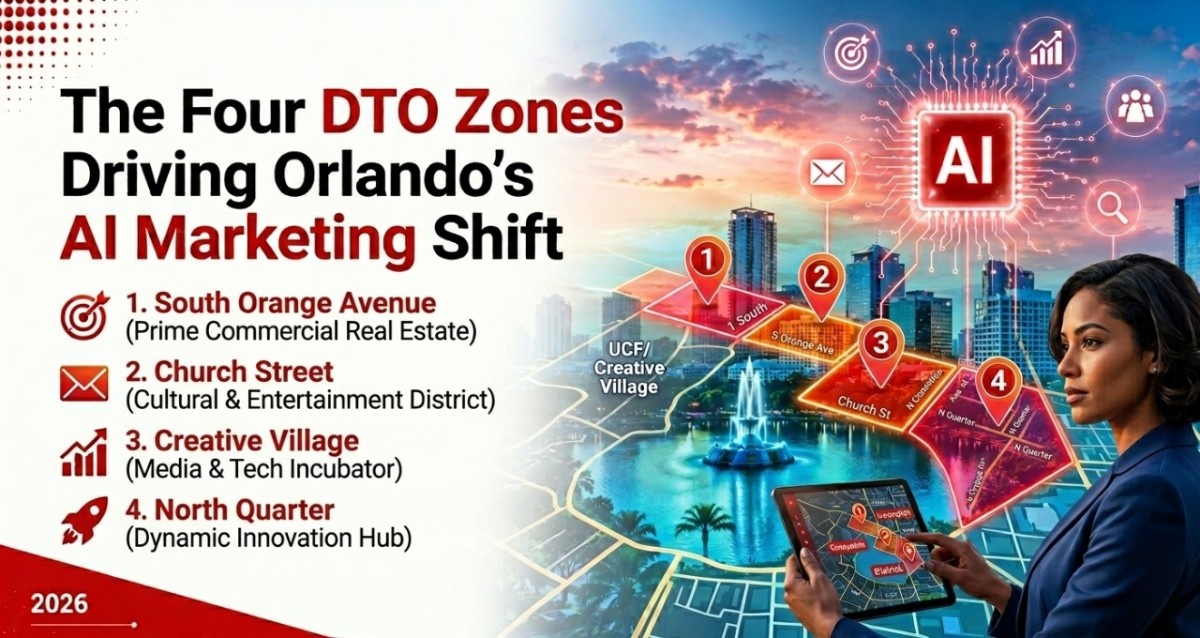
These four zones aren't just geographically close — they've each developed their own version of digital-first business culture:
The Four DTO Zones Driving Orlando's AI Marketing Shift
|
Zone |
What’s Happening There |
|
South Orange Avenue |
Dense with agencies and service businesses running AI-led campaigns daily |
|
Church Street |
Hospitality and retail brands using AI to capture tourists before rivals do |
|
Creative Village |
Tech startups building AI-first marketing from day one — it's just how they operate |
|
North Quarter |
B2B and professional firms are quietly automating outreach and lead qualification |
If your business sits inside any of these zones, or if you're competing against businesses that do, this conversation stopped being hypothetical a while ago.
What AI for Digital Marketing Actually Changes for an Orlando Business
The honest answer is that it changes what your team spends time on.
Right now, someone on your team is probably doing things that don't require human judgment; manually sorting leads, checking which ad is outperforming which, sending follow-up emails on a calendar schedule that has nothing to do with what the customer actually did. That's not their fault. It's just how marketing got built before better tools existed.
AI handles that layer. Lead scoring happens automatically based on real behavior, pages visited, time spent, search terms used, and actions taken. Ad budgets shift in real time toward whatever's converting, not whatever looked good last Tuesday. Email sequences fire when a prospect takes a specific action, not because it's Thursday and the weekly blast goes out.
What AI Marketing Automates for You
- Automated lead scoring — filters cold leads out before they eat up sales time
- Real-time ad optimization — budget moves toward winners without anyone touching a dashboard
- Behavior-triggered email — messages go out based on what someone did, not a calendar
- Predictive churn detection — flags customers who are about to leave before they do
- Personalized content recommendations — keep visitors on your site longer, automatically
Salesforce research: AI-driven personalization increases customer engagement by up to 56% compared to generic campaigns that treat every customer the same.
A Real Example — Creative Village, Orlando
A software startup based in Creative Village had a traffic problem — not too little, but too unproductive. Visitors hit the pricing page, poked around, and left. No demo booked, no form filled.
They set up an AI customer acquisition tool that tracked that exact behavior and triggered a personalized email within 18 minutes of someone leaving. Not a generic newsletter. A specific message tied to what that person looked at.
Result: Demo bookings climbed 34% over 90 days. The team didn't grow. The ad budget didn't change. Just the timing and the targeting got smarter.
Which Orlando Industries Are Seeing Real Results Right Now
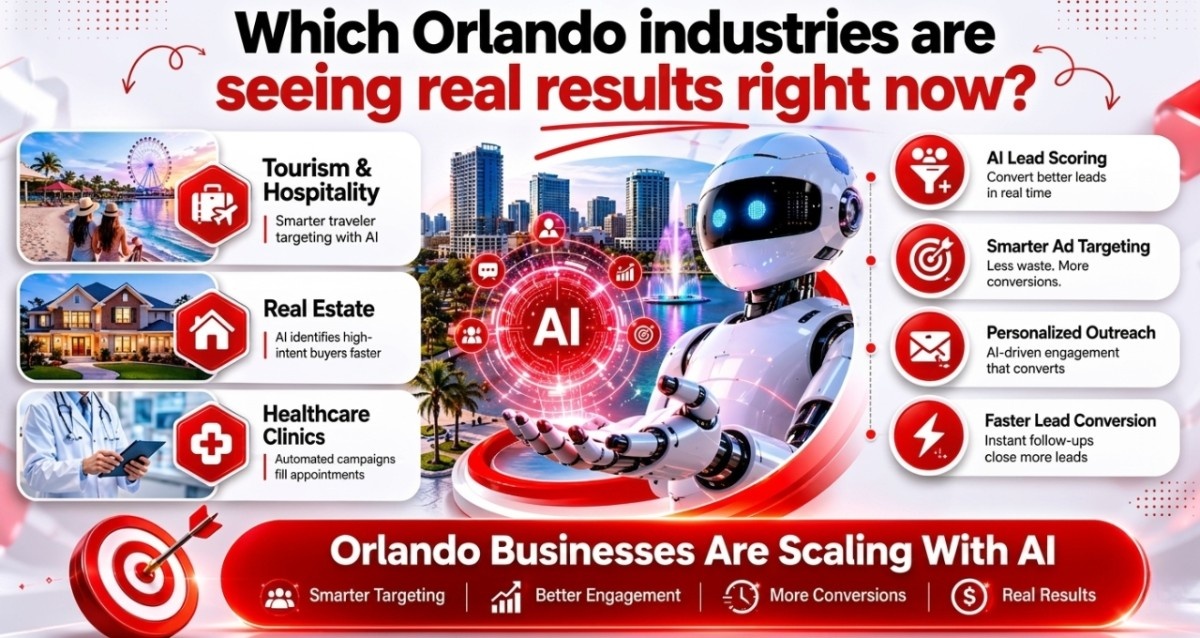
Tourism is the obvious one. This is Orlando — it lives and dies by how early you reach a traveler in the planning process. Hotels and experience brands near Church Street use AI to serve ads at the exact moment someone is searching, not after they've committed to a competitor. That window is narrow and the AI catches it reliably in a way a human-managed campaign simply can't.
Real estate has been aggressive about this, too. Agents and brokerages throughout the North Quarter use AI sales automation to sort incoming leads by readiness — who's browsing versus who's buying in the next 90 days. In a market that moves as fast as Central Florida's, calling the right person first is worth a lot.
Healthcare is further behind but catching up fast. Clinics use automated digital marketing tools to fill empty appointment slots, re-engage lapsed patients, and target new ones without running into compliance issues. The technology has gotten careful enough to work inside those guardrails.
The gap between businesses using AI marketing and those still running manual campaigns is compounding. It's not going to narrow on its own.
Can Small Businesses in Orlando Actually Afford AI Marketing?
Three years ago, no. Today, yes — and that's a genuine change worth understanding.
The original version of AI marketing required custom infrastructure, enterprise contracts, and months of implementation before anything went live. That's not what the market looks like now. A local AI marketing agency in Orlando can set up meaningful automation, lead scoring, ad optimization, triggered email sequences — for less than the monthly cost of a part-time hire.
And unlike a hire, it doesn't need onboarding. It starts collecting data on day one and gets better as it goes. Most businesses start seeing real signals — lower cost per lead, better conversion rates, fewer wasted ad dollars — within 60 to 90 days.
For a small business on South Orange Avenue trying to compete with national chains, or a B2B company in the North Quarter up against a much bigger rival, that kind of early return matters a lot.
BrightEdge data released in 2026 shows AI-driven search and discovery are reshaping how brands earn visibility online, with companies increasingly combining traditional SEO, AI-ready content, and Generative Engine Optimization (GEO) to stay competitive across Google AI Overviews, ChatGPT, and Gemini.
AI Marketing vs. Traditional Digital Marketing — The Real Difference
The cleanest way to put it: regular digital marketing is a person making decisions based on what happened last week. AI marketing is a system making decisions based on what's happening right now.
Side-by-Side Comparison
|
Factor |
Traditional Marketing |
AI Marketing |
|
Decision Speed |
Weekly reviews and manual adjustments |
Real-time, every few hours |
|
Targeting Basis |
Broad segments (age, gender, location) |
Specific behavior patterns |
|
Budget allocation |
Fixed for the campaign period |
Dynamically shifts to winning ads |
|
Email timing |
Calendar-based blasts |
Triggered by user behavior |
|
Lead qualification |
Manual review by the sales team |
Auto-scored on real signals |
|
Personalization |
Same message per segment |
Unique message per visitor |
|
Reporting cadence |
Weekly or monthly |
Live dashboards |
A traditional campaign targets a segment — "women, 30–50, Orlando, interested in wellness." An AI campaign targets a behavior pattern — this specific person who visited your site twice this week, came from a search for your exact service, and whose browsing history matches your best-converting customer profile. Those two things aren't comparable.
A boutique hotel near Church Street and a consulting firm in the North Quarter both used to need big data teams to get that kind of precision. Now it's a tool anyone can use.
How to Choose the Right AI Digital Marketing Agency in Orlando
Start by ignoring anyone whose pitch leads with the name of a software platform. "We use [tool]" isn't a strategy. It's a sales pitch dressed up as expertise. The tool is just the vehicle; what matters is whether the agency actually understands your market, your funnel, and what a realistic result looks like for your business.
A decent agency will spend the first conversation asking questions, not answering them. Where are you losing leads? What's your current cost per acquisition? What's the sales team complaining about most? Those answers shape everything.
They should also know Orlando specifically. Not just digital marketing in general — the actual local dynamics.
What to Look For in an AI Marketing Partner
- Real KPIs from day one — cost per lead, ROAS, conversion rate. Not "brand awareness."
- A clear 90-day plan, not a vague "we'll assess things first" runway
- Tools that plug into what you already have — not a full teardown and rebuild
- References from businesses your size, not just enterprise case studies on a website
Why Work With Zebra Techies Solution for AI Digital Marketing in Orlando
Plenty of agencies will take your money. Not all of them know what they're doing.
Zebra Techies Solution has been in the field for 15+ years, across 350+ clients — and we're not here to sell you software. We're here to grow your business. We understand Orlando's market, its seasonality, its industries, and what actually moves the needle here versus anywhere else.
ISO certified. Globally experienced. Completely focused on your ROI.
If you want a team that treats your growth like their own problem, you've found them.
Get a Free AI Marketing Audit →
Frequently Asked Questions
Q1. What does AI for digital marketing mean for a small Orlando business?
It means your leads get scored, your ads get optimized, and your follow-ups go out — automatically. No extra staff. Just smarter systems working around the clock.
Q2. Which Downtown Orlando areas have the most digital marketing activity?
South Orange Avenue, Church Street, Creative Village, and the North Quarter. These four DTO zones have the highest concentration of agencies and AI-forward businesses in Central Florida.
Q3. How long before I see real results from AI marketing?
Most Orlando businesses see measurable improvement — lower cost per lead and better conversions — within 60 to 90 days. Not year two. The first quarter.
Q4. Does AI marketing replace my existing team?
No. It removes the repetitive work — lead sorting, ad testing, scheduled emails — so your team focuses on decisions that actually need a human. Same people, more output.
Q5. How much does AI digital marketing in Orlando typically cost?
Pricing varies by scope, but most small and mid-sized Orlando businesses can start with AI-powered campaigns for less than the monthly cost of a part-time hire.
AI Marketing in Orlando Is Not the Future— It's Already Happening
Ready to stop leaving leads on the table?
Reach out to Zebra Techies Solution today. Let's build an AI marketing system that gets your Orlando business the growth it's been missing.

By Professional qualification a Computer Engineer, By Profession an Online Marketing Strategist and Web Application Development Expert, By Industry position working as a CEO at Zebra Techies Solution!