



Free AI Agents for Small Business: The One Catch
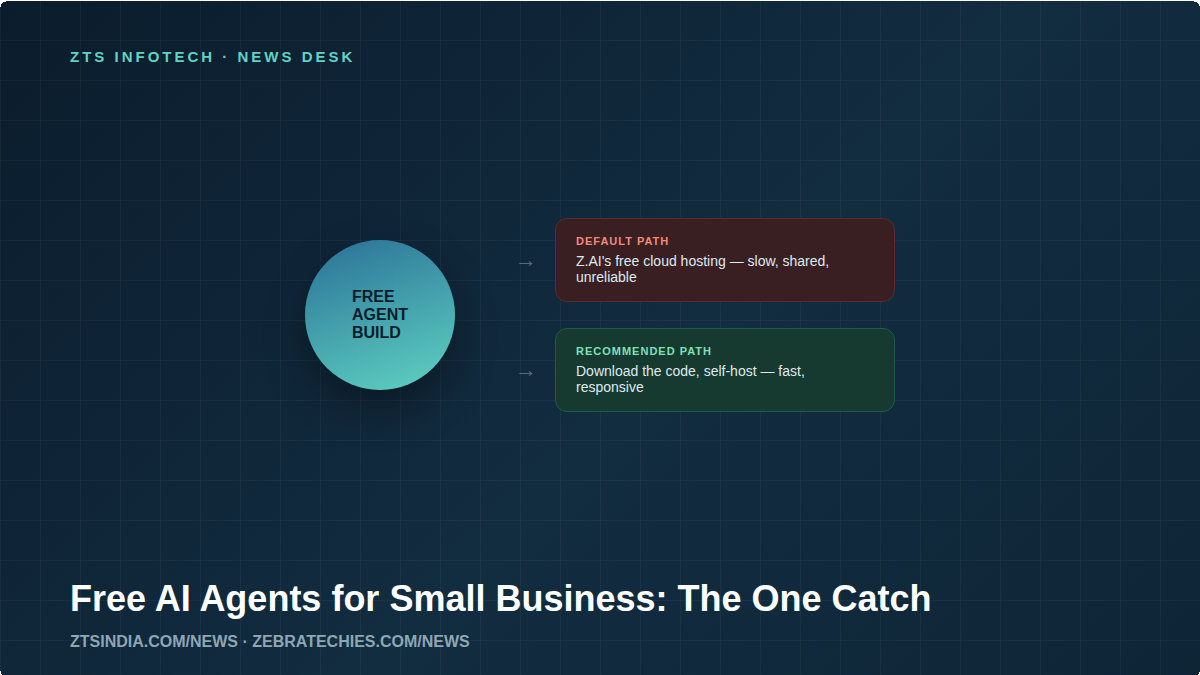
The automation pitch to small businesses has a math problem. Most AI agent platforms are built for companies that can absorb another monthly line item, and the businesses that need automation the most — the ones running lean, watching every subscription — are usually priced out first. ZTS Infotech's News Desk, in a briefing from the company's Anirban Das, addresses that gap with a walkthrough of Z.AI, a free platform the agency uses to build real client automation at zero software cost. The more useful part of the segment isn't the sign-up flow, though — it's the one configuration decision Das says determines whether the resulting agent actually works or quietly frustrates every client who tries it.
The Free Build: Three Steps, No Credit Card
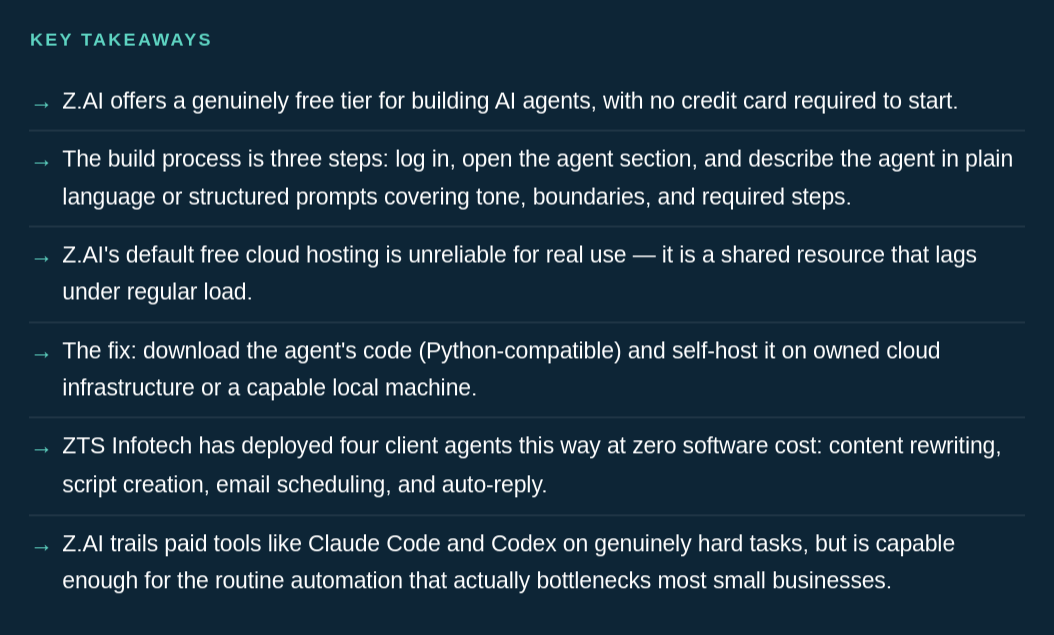
The onboarding path Das describes is deliberately unremarkable. Businesses log into Z.AI's free tier or trial without entering payment details, navigate to the agent section of the dashboard, and describe the agent they want in plain language — or use structured prompts specifying tone, boundaries, and steps the agent should never skip. Z.AI's underlying GLM model then builds the agent and, by default, offers to host it on the platform's own free cloud server. For a business evaluating whether AI automation is worth pursuing at all, that low barrier to a working prototype is genuinely valuable.
The Catch Most Guides Skip: Where the Agent Actually Runs
This is where the segment earns its credibility. Rather than presenting the free build as a finished solution, Das is explicit that the default free cloud hosting should not be trusted for anything real. It lags and responds slowly under regular use because it's a shared free resource, not infrastructure built for reliability
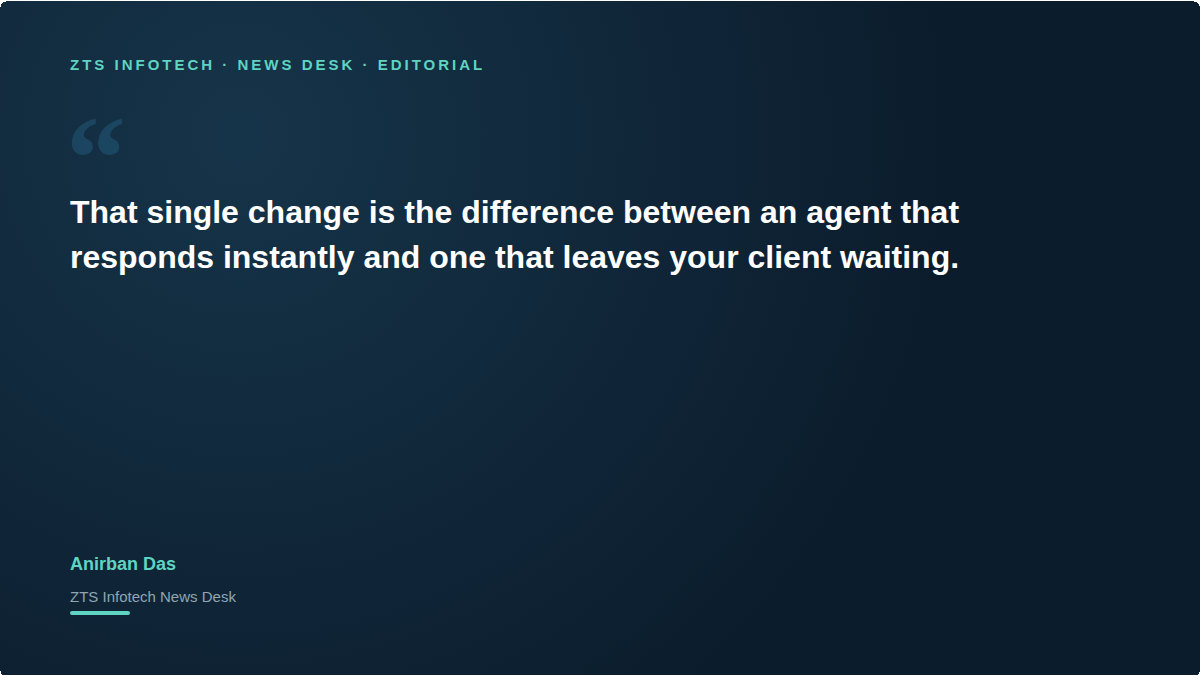
— a distinction that matters to a client waiting on a response. The fix: download the actual agent code, which runs as long as the target server supports Python, and deploy it on the business's own cloud hosting or a local machine with adequate specs. Das calls that single change the difference between an agent that responds instantly and one that leaves a client waiting — for a small business trying to prove automation is worth it, the difference between a tool that gets used and one that gets abandoned within a week.
What ZTS Infotech Has Actually Shipped This Way
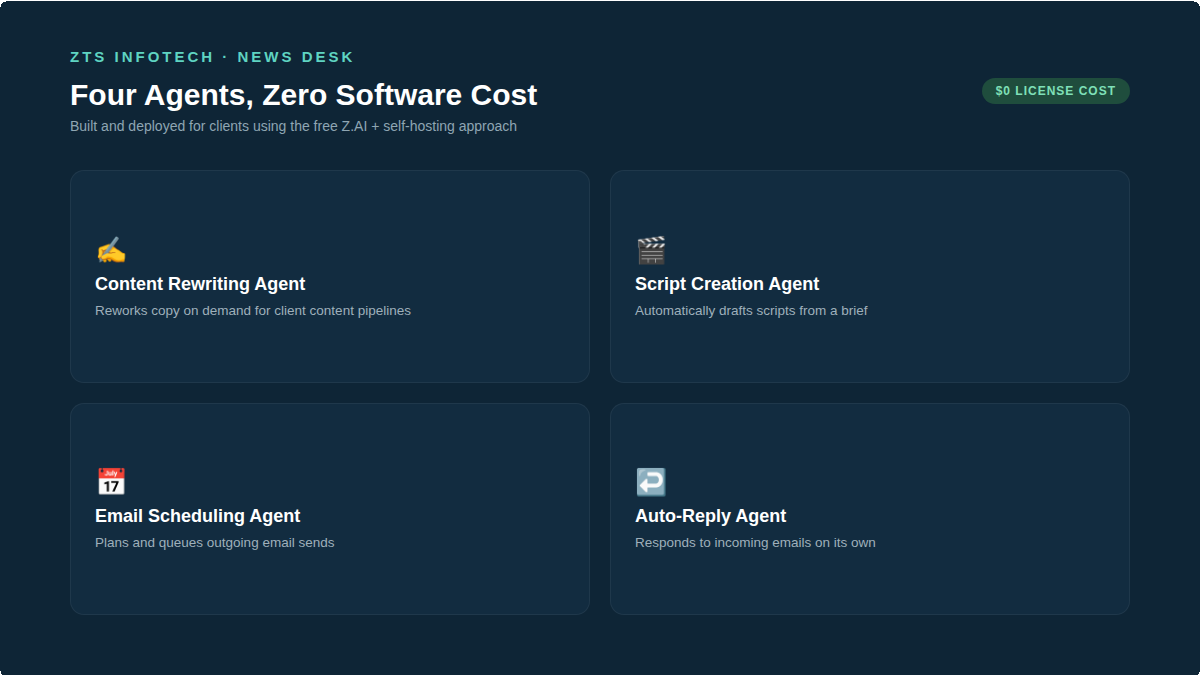
The segment doesn't stay theoretical. Das lists four agents the team has built and deployed for clients using this exact free-build, self-hosted approach: a content rewriting agent, an automatic script creation agent, an email scheduling agent, and an auto-reply agent that responds to incoming emails on its own. None of them required a paid platform license.
The Honest Limit — and Why It Doesn't Matter as Much as It Sounds
Das is equally direct about where Z.AI falls short: it is not as capable as paid tools like Claude Code or Codex on genuinely hard, complex tasks. But the segment's real argument is that most small businesses aren't bottlenecked by hard tasks — they're bottlenecked by ordinary, repetitive day-to-day work that a free, correctly hosted agent handles perfectly well. Framed that way, the capability gap becomes far less relevant than the deployment decision that determines whether the free tool performs like a professional tool at all.
Why This Matters for Budget-Conscious Business Leaders
The broader lesson here isn't really about Z.AI specifically — it's about how businesses should evaluate "free" AI tooling in general. A free model is only as good as the infrastructure it runs on, and vendors have every incentive to make their own free hosting the path of least resistance even when it's the weakest link in the setup. Businesses that treat the free tier as the finished product will get an unreliable agent and likely conclude that AI automation "doesn't work" for them. Businesses that treat it as a free model plus a hosting decision they still have to make correctly will get something that performs like paid software.
E X P E R T P E R S P E C T I V E
What stands out in this briefing is the discipline of separating two decisions that most small businesses collapse into one: which AI model to use, and where that model actually runs. Model access has gotten commoditized fast — genuinely capable free tiers now exist across multiple providers — but hosting quality has not, and it remains the single biggest lever over whether an end user experiences an agent as fast and reliable or sluggish and unusable. Agencies and
internal IT leads evaluating any free AI platform should apply the same test ZTS Infotech is describing here: assume the vendor's own free hosting is a demo environment, not a production one, and budget the modest cost of self-hosting from the start rather than discovering the lag problem after a client complains.
Conclusion
For small businesses that have written off AI automation as a subscription they can't yet justify, this framework is a reminder that the model itself is no longer the expensive part — the infrastructure decision around it is what separates a usable agent from an abandoned experiment. As free-tier AI models continue to close the capability gap with paid platforms, expect the businesses that win with automation to be the

By Professional qualification a Computer Engineer, By Profession an Online Marketing Strategist and Web Application Development Expert, By Industry position working as a CEO at Zebra Techies Solution!