



How AI is Transforming Lead Generation in Canada (2026 Guide)

How AI is Transforming Lead Generation in Canada (2026 Guide)
AI-powered lead generation is helping Canadian business owners stop chasing ghosts and start focusing on people who actually want to buy.
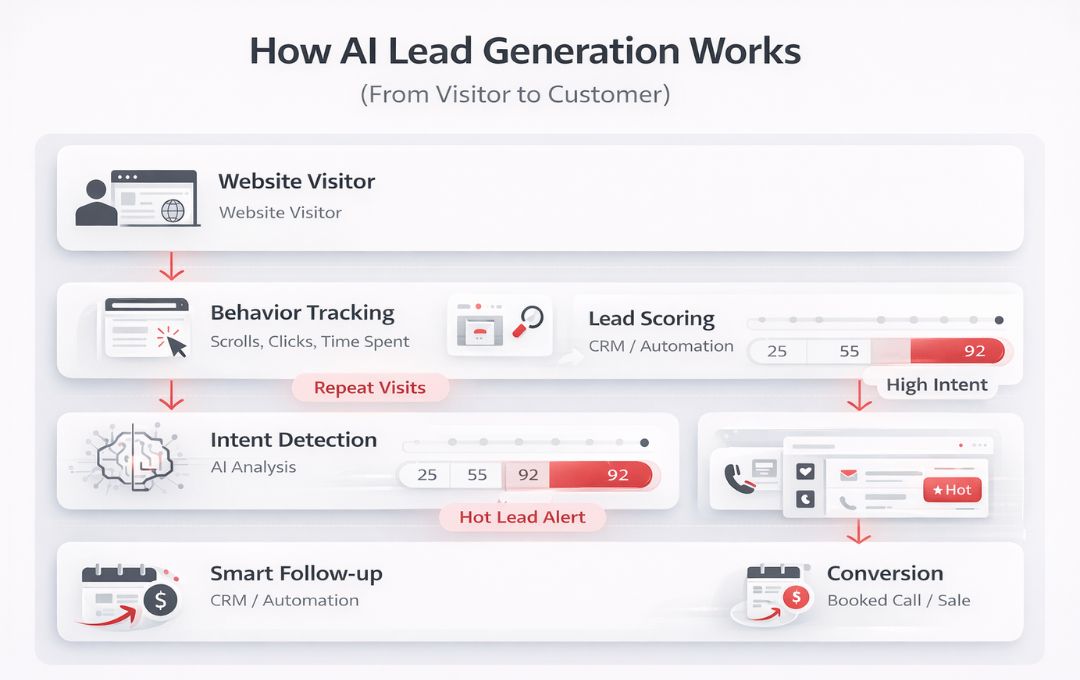
Instead of just stacking up a pile of random names, it watches how people move through your site—what they’re clicking on, how long they're staying, and if they keep coming back for more. It spots the "serious" behavior and tells you exactly when to jump in.
In simple terms:
- It’s not about getting more leads—it’s about getting better ones.
The Real Problem Most Canadian Businesses Face
If you’re running a service business in Toronto, Vancouver, or Calgary, you know the drill: You’re getting leads, but your calendar is still empty.
We hear the same story every day:
- A clinic gets 40 leads but only books 3 people.
- A contractor spends all day sending quotes and gets ghosted.
- A real estate team gets a flood of inquiries from people who are just "window shopping."
What’s going wrong?
- Ad fatigue is real: People have seen your ads a thousand times. They’re tuning out.
- Clicks are getting expensive: Paying $8–$25 per click is painful if those people aren't buying.
- Forms don’t tell the full story: Just because someone typed their name into a box doesn't mean they’re ready to sign a contract.
- Follow-ups are messy: If you don't call them at the right moment, or if you send a boring, generic email, the lead is gone.
The reality: Most Canadian small businesses see less than a 5% conversion rate until they fix their funnel. The problem isn't a lack of traffic—it's a lack of timing and quality.
A Smarter Way to Approach Lead Generation
You don't need a bigger bucket; you need to stop the leaks. The goal is to figure out who’s actually ready to move.
1. Understanding Intent (Not Just Forms)
Stop treating every person who hits your site the same way. Start looking at what they actually do:
- Which specific service pages are they reading?
- Are they sticking around or bouncing instantly?
- Is this their first visit, or their fifth this week?
- Are they hanging out on the pricing page?
Example: A person who checks your pricing page twice is worth ten times more than someone who accidentally clicked your homepage and left.
2. Tracking Real Behavior
Stop guessing what people want. You can now track "digital body language":
- How far they scroll down your page.
- Which buttons they’re actually clicking.
- How much time they spend on your "About Us" or "Services" sections.
- Whether they keep coming back to check your work.
This shows you the difference between a curious browser and a serious buyer.
3. Scoring Leads Based on Intent
Once you see the behavior, you can rank your leads so you don't waste time:
- Checking the price list → Getting serious.
- Coming back twice in 48 hours → Very interested.
- Clicking “book an appointment” → High priority.
This tells you exactly who to pick up the phone for first.
4. Timing Follow-Ups Properly
Most leads die because they sit in a CRM for three days with no action. A better approach looks like this:
- Get that behavior data straight into your CRM.
- Trigger an alert the moment a lead shows high interest.
- Reach out while you’re still top-of-mind.
Example: If someone visits your service page twice in one afternoon but doesn’t fill out the form, they’re still a "hot" lead. They might just need a quick, helpful text to get them over the finish line.
Why Most Tools Don’t Work (Especially in Canada)
You’ve probably tried the usual suspects—chatbots, basic automation, or standard forms. Here’s why they usually fall flat:
- Chatbots are robotic: They ask the same three questions and treat every visitor like a number. You get more "conversations," but they’re usually useless ones.
- Generic tools don't get Canada: Between PIPEDA privacy laws, the need for bilingual content in Quebec, and how we search locally, most "standard" tools just don't fit the Canadian market.
- Forms are too easy: If it’s too easy to fill out a form, you get a lot of junk. You end up wasting your workday chasing people who were never going to hire you.
Real Examples from Canadian Businesses
Clinics → Better Bookings An Ontario clinic stopped chasing every "click" and started looking for repeat visitors to their treatment pages. By focusing on people who were clearly doing their research, they filled their schedule with patients who actually showed up.
Contractors → Higher-Quality Leads A GTA contractor started ranking leads based on how long they spent looking at their project portfolio. They stopped wasting time on "price shoppers" and focused on the leads who clearly liked their specific style of work.
Real Estate → Serious Buyers Only In Vancouver, one team started tracking how many times people looked at the same house. Instead of calling every new sign-up, they called the people who were clearly obsessed with a specific listing.
What Makes This Approach Different
Let’s be blunt about what this is.
This is NOT:
- Another annoying chatbot.
- A trick to get "cheap" traffic.
- An excuse to spend more on Google Ads.
What it IS:
- Choosing quality over a high "lead count."
- Making moves based on what people actually do on your site.
- Getting your timing right so you're helpful, not annoying.
A Better Way to Think About Leads
If you're tired of high ad costs, low-quality inquiries, and wondering where your next client is coming from, the answer isn't "more tools." It's clarity.
- Who is actually going to buy?
- Who is just looking?
- When is the best time to talk to them?
When you know those three things, you stop wasting time, your sales go up, and your business becomes a lot more predictable. In a trust-based market like Canada, that’s the only way to win.
Frequently Asked Questions
What is AI lead generation in Canada? It’s a way to spot your best potential customers based on their actions, not just a form submission, while staying on the right side of privacy laws like PIPEDA.
How is it different from traditional marketing? Traditional marketing is about "how many people can we get?" AI lead generation is about "which of these people are actually worth talking to?"
Does it replace my CRM? No. It just plugs into your CRM and gives it the "brain" it's currently missing.
Is it compliant with Canadian privacy laws? Yes—as long as you’re being transparent about tracking and handling data securely.
Will it work for small businesses? It’s actually better for small businesses because you don't have the time or staff to waste on bad leads.
Do I need a big budget? Not at all. This is about making the most of the people already visiting your site.
Final Thought:
AI-driven lead generation is not about chasing more traffic—it’s about understanding intent, improving timing, and focusing on quality over quantity. As highlighted, Canadian businesses that shift from generic approaches to behavior-based insights see better conversions, less wasted effort, and more predictable growth.
By identifying serious buyers, tracking real engagement, and responding at the right moment, businesses can turn missed opportunities into consistent results. In a competitive and trust-driven market like Canada, success comes from clarity—knowing who to prioritize and when to act.

By Professional qualification a Computer Engineer, By Profession an Online Marketing Strategist and Web Application Development Expert, By Industry position working as a CEO at Zebra Techies Solution!