



The AI-First Revolution: How Artificial Intelligence Is Reshaping Web Design, Mobile App Development, and Digital Marketing in 2026
Let's be honest. The internet doesn't look the same as it did three years ago, and neither does the process of building it.
If you've worked in tech, design, or marketing for any stretch of time, you already sense that something fundamental has shifted. The tools are smarter. The timelines are tighter. And client expectations? Completely different territory.
Welcome to the AI-First era, where the question isn't whether artificial intelligence belongs in your workflow, it's how quickly you can make it work for you.
The Shift Nobody Saw Coming (But Everyone Felt)
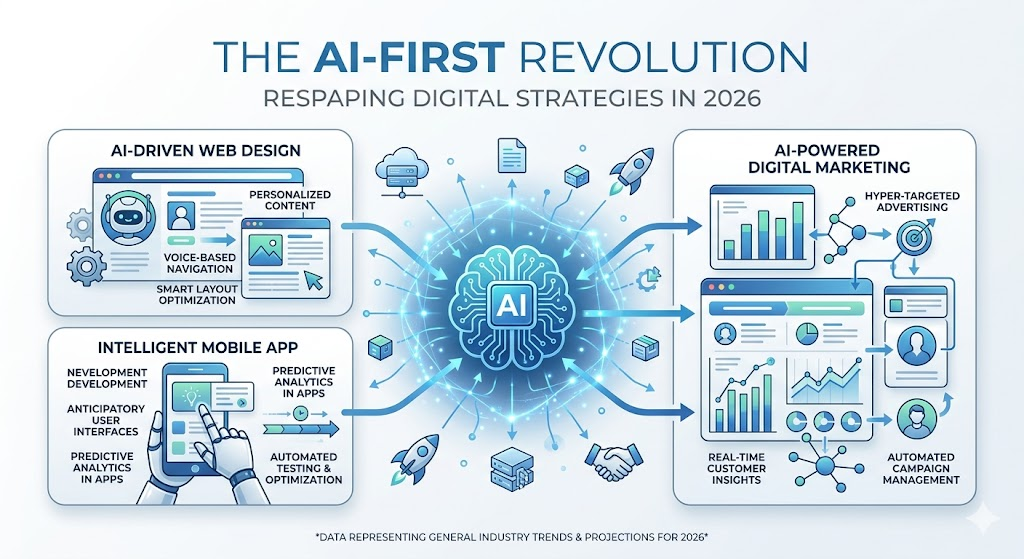
In 2024, AI was a novelty layer, something you sprinkled on top of existing processes. In 2026, it's baked into the foundation. From the first wireframe to the final deployment, AI now touches every stage of web design and development.
But here's the thing most agencies won't tell you: AI doesn't replace the humans doing the work. It just removes the slow parts so the talented ones can do more of what they're actually good at.
What "AI-First" Actually Means for Web Design
There's a huge difference between "using AI" and being AI-first.
Using AI means dropping a prompt into a tool and hoping something usable comes out. Being AI-first means your entire design thinking, prototyping, and iteration cycle is architected around AI capabilities, with human judgment steering every critical decision.
In practical terms, for website design and development, this looks like:
- Designers using AI to generate dozens of layout variations in the time it used to take to sketch two
- AI analyzing competitor websites, user behavior data, and brand guidelines simultaneously, surfacing insights that a human researcher might take days to compile
- Developers getting AI-assisted code generation that they then review, refine, and customize, cutting development time without cutting corners
The result is a product that's built faster and built better. Not one or the other.
The Human-AI Collaboration Model That's Actually Working
At ZTS Infotech Pvt. Ltd., we've spent considerable time thinking about what genuine collaboration between human intelligence and artificial intelligence looks like in practice, not in theory.
The answer we've landed on: AI + HI (Human Intelligence) isn't a formula, it's a rhythm.
AI handles the heavy lifting of generation, iteration, and pattern recognition. Human designers and developers handle context, taste, emotional resonance, and the kind of strategic thinking that no model can replicate. The two work in tandem — each doing what it's genuinely best at.
Think of it this way. A seasoned developer reviewing and refining AI-generated code is not doing less work, they're doing better work. They're operating at a higher altitude. Same goes for a designer using AI to rapidly prototype variations they can then critique and evolve.
This collaborative approach doesn't just accelerate projects. It produces outputs that neither humans nor AI could reach working alone.
Mobile App Development in the AI-First World
The mobile app development landscape in 2026 is barely recognizable compared to even three years ago.
AI is now embedded across the entire development lifecycle:
- Discovery & Planning - AI tools analyze market data, similar apps, and user demographics to sharpen product strategy before a single line of code gets written.
- UI/UX Design - Generative design tools propose interface patterns based on the app's purpose, target audience, and accessibility standards. Human designers then curate, refine, and inject personality.
- Development - AI-assisted coding environments have genuinely changed what's possible in a given sprint. Developers describe what they need, AI scaffolds it, and developers make it production-ready.
- Testing - Automated AI testing can now simulate thousands of user journeys, catching edge cases that manual QA would almost certainly miss.
- Post-Launch - Predictive analytics tools monitor user behavior and flag friction points in real time, allowing teams to respond before small problems become churn.
What used to take six months can now move significantly faster without sacrificing quality, provided the team knows how to work with AI, not just around it.
Digital Marketing Has a New Playbook
It's not just product development that's been remade. Digital marketing in 2026 runs on AI infrastructure.
Personalization, real personalization, not the kind where a website shows you the same item you just bought, is now achievable at scale. AI analyzes behavioral signals in real time and adjusts everything from ad copy to landing page headlines to email send times.
Content strategy has shifted, too. The brands winning attention right now are the ones using AI to identify gaps in their market's content landscape, develop topic clusters intelligently, and produce assets that actually answer what their audience is searching for, while human writers ensure the voice, nuance, and credibility that AI alone can't manufacture.
For companies working with a digital solutions partner like ZTS Infotech, this means marketing and product development finally work from the same intelligence layer, not separate silos with separate data.
Why the "AI or Humans" Debate Was Always the Wrong Question
A lot of noise in the last two years has been spent on the wrong argument. The real question was never AI or humans. It was always about understanding which tasks belong to which kind of intelligence.
The agencies and companies that get this are building extraordinary products at speeds that would have seemed implausible in 2022. The ones still debating it are watching from the sideline.
At ZTS Infotech, the approach has always been rooted in genuine collaboration, between disciplines, between team members, and now between human and artificial intelligence. The web and mobile solutions we build reflect that philosophy at every level.
Looking Ahead
2026 is not the endpoint of this revolution. It's closer to the beginning.
The capabilities available right now will look modest twelve months from now. Which means the teams building AI-fluency today, embedding it into their culture, their processes, their client conversations, are developing a competitive advantage that compounds over time.
If you're thinking about a digital product, a redesign, or a marketing overhaul, the best time to build it with AI at the center was a year ago. The second best time is now.

By Professional qualification a Computer Engineer, By Profession an Online Marketing Strategist and Web Application Development Expert, By Industry position working as a CEO at Zebra Techies Solution!