



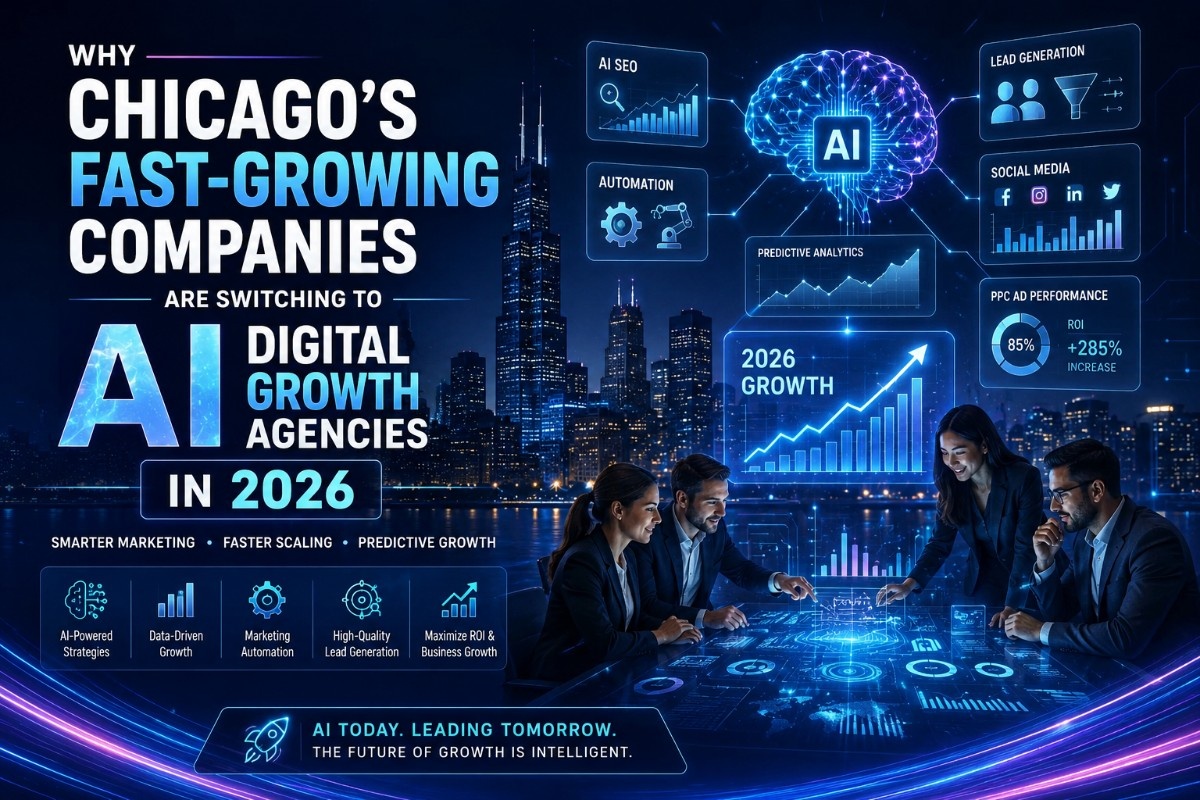
Why Chicago's Fast-Growing Companies Are Switching to AI Digital Growth Agencies in 2026
You Can Feel the Shift in This City
Had coffee with a founder last month. Won't name her, but she runs a SaaS company out near Fulton Market, doing real numbers, growing fast. About fifteen minutes in she put her cup down and said, "I fired my agency last quarter. Honestly? Should've done it a year ago."
I asked her why.
She thought about it for a second. "They were charging me 2026 prices for 2018 thinking."
That one stuck with me. Because I keep hearing some version of the same story. From founders in Wicker Park. From CMOs at logistics firms out by O'Hare. From eCommerce people in River North who are watching their CAC climb every month while their agency keeps sending these polished Friday reports that don't really say anything.
Something has shifted here. The sharper businesses in Chicago aren't asking the old questions anymore. They're not asking who has the biggest team or the flashiest office on Wacker. They're asking one thing, and they're blunt about it. Do you actually use AI, or did you just put it on your About page?
And when they don't like the answer, they leave. Quietly, mostly. But they leave. And a lot of them are landing at an AI digital growth agency instead.
Let me walk you through what's happening, because if you're running anything in this city, you should know.
Why the Old Agencies Are Quietly Losing
I'll say what most people in our industry won't say out loud. Most traditional shops in Chicago are still running a 2018 playbook. The people are smart. The shops are well-run. That's not the issue. The model is the issue.
Think about how a normal retainer agency works. You pay them every month. They give you an account manager who probably has eight other clients. There's a strategist somewhere, a media buyer who pulls levers a few times a week, a designer, maybe a copywriter who's on a freelance contract. Dashboards get checked on Tuesdays. Reports go out on Fridays. Optimization happens when somebody has a free hour between meetings.
Now think about the world this is operating in. Ad auctions are running thousands of times a second. Buyer intent shifts week to week. Your competitor changes pricing before your account manager finishes their morning matcha. The platforms reward speed, personalization, and signal reading at a level a human team just can't pull off. Not at scale. Not consistently.
So what happens? Costs creep. Performance flattens out. The Friday report starts looking like the last Friday report, just with worse numbers.
A few specific places where the wheels come off:
The optimization is too slow. A human checking campaigns twice a week is not going to beat a model rebalancing budgets every fifteen minutes. That's not a knock on the human. It's just arithmetic.
The creative is too generic. One brand voice, three ad variants, and a prayer that something hits. Buyers don't reward that anymore. They reward creative that feels like it was made for them.
The reporting is backward-looking. Showing me what happened in October is fine. Telling me what's coming in December? That's the bar now.
The tech stack is duct tape. Five tools, three spreadsheets, two attribution models that don't agree, and nobody on the team can really tell you which lead came from where.
Founders feel all of this. Daily. They're writing checks for ten, fifteen, twenty-five thousand a month and watching CAC drift upward. Eventually they start asking friends who they're using. And that's usually how they end up sitting across from an AI digital marketing agency in Chicago that's built on a different chassis entirely.
The Quiet Rise of the AI Digital Growth Agency
There's a new kind of shop growing in this city. Some people call them AI-first studios. Some call them growth partners. I just call them what they are, an AI digital growth agency, because growth is what the work is actually about. The label matters less than what they do.
Here's the real difference. These agencies didn't just add "AI" to their homepage. They tore down the old delivery model and rebuilt the whole thing around it. Predictive analytics drives who gets targeted and when. Generative models produce creative across dozens of variants. Machine learning scores leads in real time. Marketing automation tools handle the heavy lifting so the strategists can spend their time on, you know, strategy, instead of pulling reports.
Why is this taking off in Chicago specifically? Couple of reasons I think matter.
We're a city of operators. That's not a brand thing, that's just true. Chicago founders don't fall for hype the way some markets do. We adopt fast when something works and drop fast when it doesn't. AI is working, and the receipts are showing up in P&L statements all over town.
The business mix here helps too. This isn't a one-industry city. Logistics, fintech, healthtech, manufacturing, food and beverage, professional services, all of them need to grow, all of them are hitting the same wall with their old agencies. AI digital marketing in Chicago has stopped being a niche play. It's the default now for serious operators.
And then there's the talent. A lot of strong AI engineering and data science people work here. Some of them are now in marketing services, which has changed what's possible. You can do things in 2026 that just weren't realistic two years ago.
How AI Has Rewritten Lead Generation and Customer Acquisition
This is the part where founders usually sit up. Lead gen has always been the engine of B2B and service businesses in this town, and AI has rewritten how it actually works.
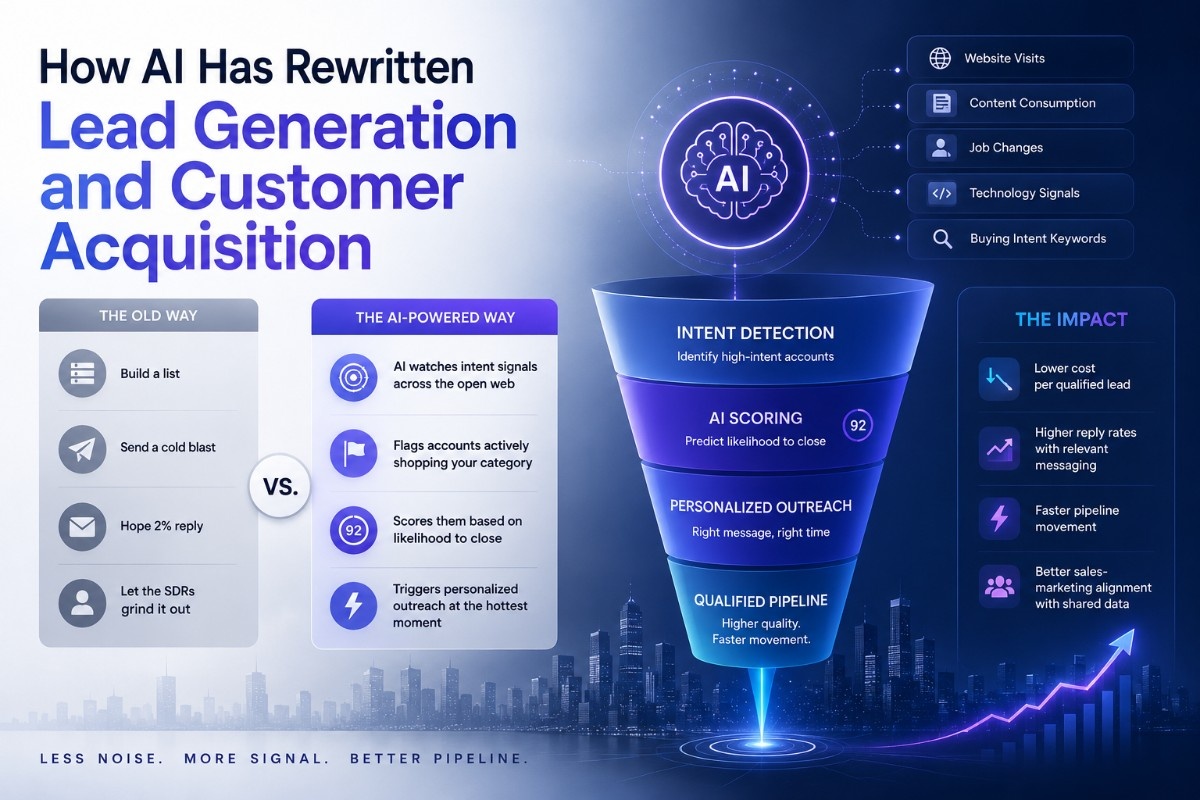
Old way? Build a list, send a cold blast, hope 2% reply, let the SDRs grind it out. New way? AI watches intent signals across the open web, flags accounts that are actively shopping your category, scores them based on how likely they are to close, and triggers personalized outreach right when the signal is hottest.
Companies running this properly are seeing things you couldn't pull off manually. Lower cost per qualified lead, because the junk gets filtered before sales ever touches it. Higher reply rates, because the message is based on real behavior, not a guess. Faster pipeline movement, because leads come in already warmed by content that actually matched their intent. Better sales-marketing alignment, because for once, both teams are looking at the same data and not arguing about whose number is right.
Customer acquisition works on the same engine. AI customer targeting can surface lookalike audiences your team never would have found manually, then test creative variants across micro-segments to figure out what actually moves the needle. That's not future-state pitch deck stuff. That's a Tuesday afternoon for a well-built AI-powered campaign.
What Chicago Businesses Are Actually Getting Out of This
I've talked to enough operators here who've made the jump that I can tell you what they say. It's pretty consistent.
They talk about speed first. Tests that used to take three weeks now take three days, sometimes three hours. That alone changes how a marketing team plans.
They talk about targeting. AI doesn't get tired, doesn't carry assumptions, doesn't say things like "we tried that audience two years ago and it didn't work." It just keeps looking until it finds where the buyers actually are.
They talk about real conversion optimization. Not the "let's test the button color" version. Real testing, across headlines, offers, layouts, audiences, all of it running at once, all of it feeding back into the same loop.
They talk about forecasting. Predictive analytics finally gives a founder something they've never really had, a credible read on what next quarter looks like based on what's in the funnel today.
They talk about waste, or rather, the lack of it. Budget stops dripping into channels that don't earn their keep. ROAS climbs because every dollar is being routed by data-driven marketing logic, not by what felt right at the annual planning offsite.
And then they talk about scale, which is the one most people underestimate. Old marketing scales linearly. You want more output, you hire more humans. AI-driven marketing scales the other way. Same headcount, ten times the experiments, ten times the audiences, ten times the creative volume tested. Once you've seen it work, going back feels like swimming with weights on.
A Few Real Stories (No Names, but Real)
Let me make this real, because abstract claims don't help anyone make a decision.
A Chicago SaaS company selling workflow software to mid-market firms was burning cash on LinkedIn ads and getting demos that mostly went nowhere. They brought in AI-driven intent data, started targeting accounts that were already poking around competitors' sites, and served them creative that hit the specific pain points those buyers were searching on. Cost per demo dropped almost in half over two quarters. Same budget. Different brain behind the targeting.
A premium home goods brand based in River North used AI-powered campaigns to personalize their email flows. Instead of one welcome series sent to everyone, the system generated dozens of variants tied to actual browsing behavior. Email revenue went up, and the marketing manager finally stopped working Saturdays. Two wins from one move.
A professional services firm in the West Loop felt invisible in a market full of louder competitors. They used AI social media marketing to test hundreds of content angles on LinkedIn over a few months. Eventually one angle, something around operational risk that nobody had been talking about, started crushing everything else. They rebuilt their whole content strategy around it and inbound jumped.
A local healthtech startup used predictive analytics to score every inbound lead in real time. Sales stopped chasing every form fill and focused on the top 20% the model flagged as likely to close. Win rates climbed. Sales cycles got shorter. Revenue per rep went up. Their VP of Sales told me it was the first time in his career he actually trusted the lead score.
None of these are unicorn outcomes. This is what happens when a real AI digital growth agency partners with a business that's ready to move.
How to Tell a Real AI Agency From One That's Just Pretending
Not every shop claiming to do AI is actually doing it. Some are using ChatGPT to draft blog posts and calling that transformation. So if you're shopping for an AI digital marketing agency in Chicago, here's what I'd actually look at.
Ask them to walk you through their stack. Make them get specific. Which models, which data sources, how do they measure model performance, how do they handle edge cases. If they get fuzzy, that's your answer.
Look at how they price. Shops that actually trust their AI tend to tie compensation to outcomes. Hours-based billing on AI work is a tell.
Demand transparency. You should be able to see how leads are scored, how budgets are allocated, how decisions are getting made. Black boxes are a problem.
Make sure there are real humans behind the AI. Strategy is still a human game. The AI is a tool. The shops that win pair smart strategists with serious tech. Either piece alone isn't enough.
Confirm they understand Chicago. Sounds basic, but it matters. Buyer behavior here is not Bay Area behavior. Or New York behavior. An agency rooted in this market sees things outsiders miss.
Ask for proof. Real numbers. Real Chicago clients. If they get vague or only show you decks from companies in other markets, you have a decision to make.
Where Zebra Techies Fits Into All of This
Zebra Techies sits right at the intersection of marketing strategy and AI execution, which honestly is exactly where the action is right now. The team works with Chicago startups, SaaS companies, eCommerce brands, and service businesses to build digital growth strategies that pull together predictive analytics, AI lead generation, automated campaign management, and creative testing at scale.
What I appreciate about how they work is that they don't lead with the tech. Every engagement starts with the actual business problem, not the shiny tool. From there, the right mix of AI marketing automation, audience modeling, and conversion optimization gets built around the problem. Clients walk out of meetings with clarity, not a dashboard packed with metrics they can't do anything with.
For businesses that have outgrown their old agency, or never really found one that delivered, Zebra Techies keeps coming up in the conversation. Not because of slick marketing. Because the work actually performs.
Want to see what AI-driven growth could look like for your business? Check out Zebra Techies' AI Lead Marketing services in Chicago →
Where This Is All Heading
Quick prediction, because you should be thinking about this whether you act on it or not.
Over the next 12 to 24 months, the gap between businesses that adopted AI early and those that didn't is going to get really ugly. The ones running data-driven marketing on AI rails will keep compounding. Smarter targeting drives more conversions, more conversions feed more training data, more training data drives even sharper targeting. It's a flywheel. And once it's spinning, catching up is brutally hard.
You'll see AI move deeper into creative production. Into voice and video personalization. Into real-time pricing. Into conversational sales. Attribution is finally going to start working the way it always promised to, because the models can stitch signals together in ways humans never could. The line between marketing and product is going to keep getting blurrier.
For Chicago, this is a real opening. We've got the talent. We've got the business mix. We've got the operator mindset to actually do something with it. The companies that move first on AI digital marketing in Chicago are going to define their categories for the next decade. The ones who wait are going to spend a lot of that decade trying to catch up.
So, What Should You Actually Do?
Here's the truth. The companies switching to an AI digital growth agency right now aren't doing it because it's fashionable. They're doing it because the math works. Lower CAC. Higher LTV. Faster pipeline. Better forecasting. Real scalability. None of these are nice extras. They're the difference between a business that compounds and one that just kind of sits there.
If you're running something in this city and you want to grow without lighting cash on fire, this is the moment to take AI seriously. Not as a side experiment. As the actual spine of how you go to market.
Want to see what an AI digital marketing agency in Chicago could actually do for your numbers? Book a conversation with Zebra Techies → and let's get into it.
Frequently Asked Questions
1. What is an AI digital growth agency, really?
It's an agency that built its whole workflow around AI, predictive analytics, and marketing automation, rather than bolting AI onto a regular retainer model. The outcome is faster optimization, sharper targeting, and better customer acquisition economics.
2. What does it cost to work with an AI digital marketing agency in Chicago?
Depends on scope, but most Chicago businesses end up investing somewhere between five and thirty thousand a month based on goals, channel mix, and how deep the AI capability goes. The better question is ROI, and AI-driven marketing usually returns more per dollar than the old model.
3. Can small businesses and startups actually benefit from this?
Yes, often more than bigger companies. Smaller businesses have less margin for waste, and AI-powered campaigns let them compete with bigger players through targeting and automation they couldn't afford to staff up manually.
4. How fast will I see results?
Early signals usually show up in the first 30 to 60 days, things like better lead quality, lower CAC, stronger engagement metrics. The bigger compounding gains tend to show up between months three and six, once the models have enough data to really start optimizing.
5. Is AI going to replace the humans on my marketing team?
No. AI handles scale, speed, pattern recognition. Humans handle strategy, creativity, brand, judgment. The best AI digital marketing agencies in Chicago combine both. Tech that scales alongside people who think.
Conclusion: Don't Wait Too Long on This
Here's the truth. The founders in Chicago making the switch right now aren't doing it because it's trendy. They're doing it because the math works. Lower CAC. Faster pipeline. Forecasting you can actually plan around. Growth that doesn't require doubling headcount.
And the gap is widening. The businesses that moved on AI six months ago are already pulling ahead, and catching up gets harder every quarter you wait.
You don't need to blow up your whole marketing setup tomorrow. You just need to start asking the right questions with people who actually live in this space. That's where Zebra Techies comes in. No buzzwords, no fluff. Just a real look at your numbers and a clear plan for what a smarter growth engine looks like in 2026.
Chicago rewards operators who move first. This is one of those moments.

By Professional qualification a Computer Engineer, By Profession an Online Marketing Strategist and Web Application Development Expert, By Industry position working as a CEO at Zebra Techies Solution!