



Silicon Valley’s 2026 SEO Shift: Why CEOs Now Care More About Revenue Than Rankings
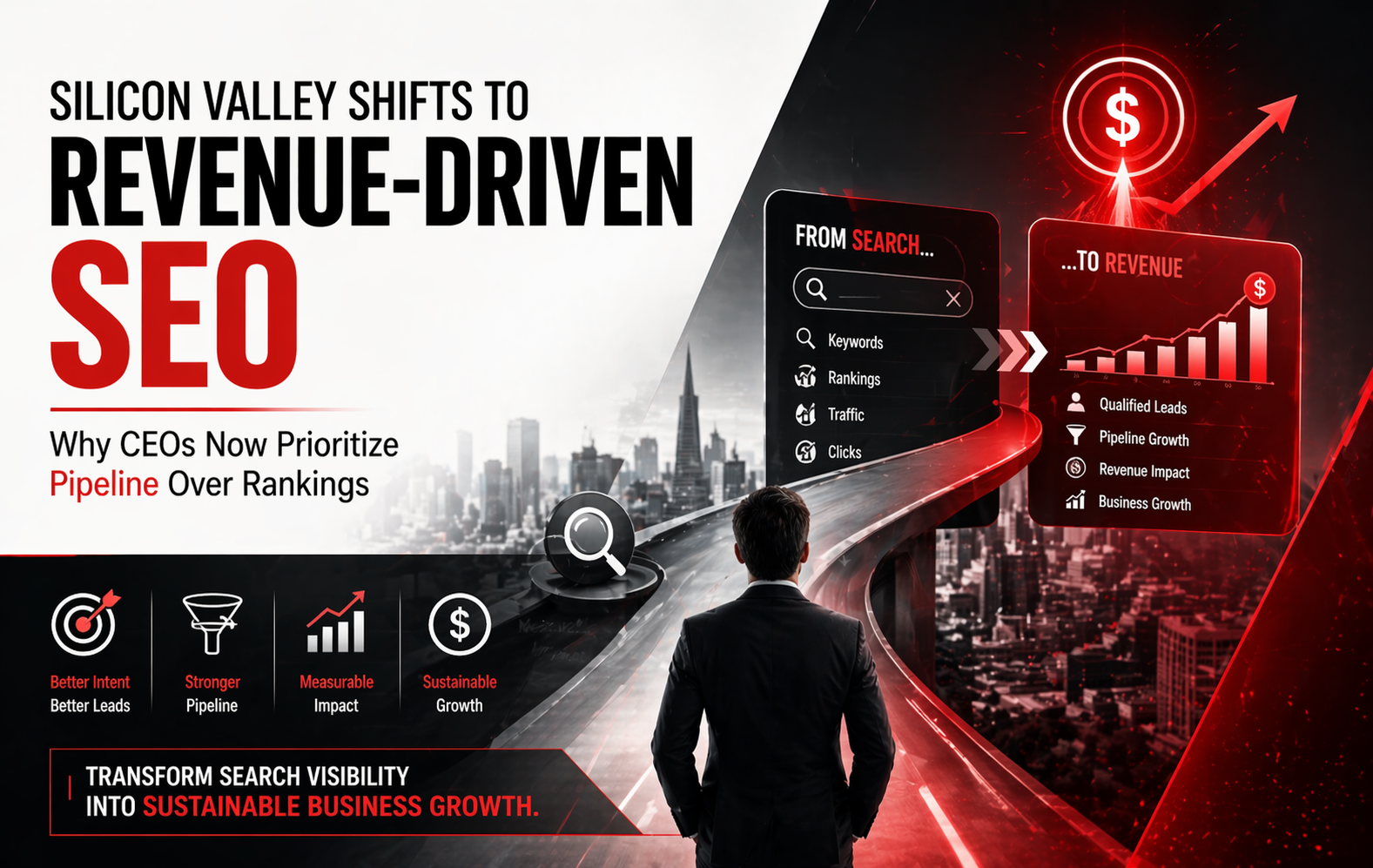
By 2026, the primary inquiry in Silicon Valley boardrooms has pivoted from "Where do we rank?" to "What is the financial yield of our organic search footprint?" This transition has cemented the era of Revenue-Driven SEO, a methodology where success is quantified by high-intent leads, sales pipeline velocity, and first-touch attribution. As conversational search tools and generative overviews redefine how buyers discover solutions, the old guard of SEO reporting—historically built on vanity metrics—is being replaced by a focus on tangible business growth.
Why Rankings Alone No Longer Impress CEOs
For decades, SEO success was defined by first-page placements and massive traffic spikes. While these metrics look impressive in a quarterly review, leadership teams eventually identified a critical gap: visibility is not a substitute for value.
A brand can dominate the search results for high-volume keywords and still fail to move the needle on annual targets. Traffic devoid of intent is a drain on resources, not an asset. This realization is why high-growth companies are abandoning traditional "visibility-first" models in favor of a revenue-centric approach.
Instead of focusing exclusively on rankings, modern teams now track:
- Lead Quality: Distinguishing between casual browsers and high-value decision-makers.
- Pipeline Attribution: Mapping how organic search initiates or accelerates the sales cycle.
- SQLs (Sales Qualified Leads): Moving beyond "contacts" to legitimate sales opportunities.
- Customer Acquisition Cost (CAC): Ensuring organic growth remains cost-effective compared to paid media.
- Lifetime Value (LTV): Analyzing if customers sourced via search remain loyal over the long term.
What Is Revenue-Driven SEO?
At its core, Revenue-Driven SEO is the strategic alignment of search optimization with commercial outcomes. It moves away from broad-spectrum content and focuses on the "Buyer’s Journey" with surgical precision.
It addresses four critical pillars:
- Conversion Pathing: Which specific pages serve as the primary gateways for qualified inquiries?
- Intent Intelligence: Which keywords indicate a readiness to purchase versus a desire for general information?
- Persona Resonance: Does the content speak the language of executives and budget-holders?
- Channel Synergy: How does organic search support other revenue streams like LinkedIn outreach or direct sales?
By prioritizing "better visitors" over "more visitors," businesses ensure that every dollar spent on content is an investment in future revenue rather than just a boost in server logs.
Traditional SEO vs. Revenue-Driven SEO
|
Traditional SEO |
Revenue-Driven SEO |
|
Focus on Keyword Rankings |
Focus on Revenue Contribution |
|
Total Organic Traffic Volume |
Qualified Lead Generation |
|
Click-Through Rate (CTR) |
Sales Pipeline Growth |
|
Backlink Quantity |
Conversion Performance |
|
Last-Click Reporting |
First-Touch & Multi-Touch Attribution |
|
Static Monthly Ranking Reports |
Executive Revenue Dashboards |
The Disruption of the Discovery Phase
The biggest challenge facing modern marketers isn't just a changing algorithm; it's the fragmentation of the buyer's path. With the rise of generative search behavior, the journey to a purchase is no longer a straight line.
A prospective client may first learn about a solution through a conversational summary. They might then see a thought-leadership post on LinkedIn, and only then perform a branded search to book a demo. In a "last-click" world, the branded search gets all the credit. In reality, the initial discovery was the true catalyst.
Why First-Touch Attribution is the New Gold Standard
To accurately calculate SEO ROI in 2026, companies must understand where the relationship began. First-touch attribution allows a business to see that a high-ticket enterprise deal actually started with a niche technical article or a recommendation weeks prior.
This clarity helps brands understand:
- Where the initial trust was established.
- Which "top-of-funnel" topics are actually worth the investment.
- How to optimize for "Answer Engines" to ensure they are part of the initial consideration set.
The Silicon Valley Standard: Pipeline, Not Projects
In tech hubs like San Jose, Palo Alto, and Mountain View, the tolerance for marketing fluff is at an all-time low. Whether it’s B2B SaaS, MedTech, or Cybersecurity, CEOs are demanding financial transparency. They aren't looking for a report that shows a jump from position #10 to position #4; they want to see the Pipeline Value created this quarter.
Case Study: The Santa Clara Cybersecurity Firm
Consider a startup ranking #1 for "what is endpoint security." They receive 50,000 hits a month, mostly from students. Meanwhile, a competitor targets "compliance-ready endpoint security for healthcare providers." They only get 500 hits, but 5 of those are CIOs at major hospitals.
The latter strategy is the essence of Revenue-Driven SEO. It treats search as a Revenue Operations (RevOps) function rather than a creative side project.
.png)
How Zebra Techies Solution (ZTS) Navigates This Pivot
One organization that has gained significant traction in this shift is Zebra Techies Solution, commonly known as ZTS. By positioning themselves at the intersection of search technology and lead generation, they have moved away from the "agency" stereotype toward a "growth partner" model.
Operating across the Silicon Valley corridor—including Cupertino, Sunnyvale, and Menlo Park—ZTS has focused its service suite on high-impact areas like:
- Generative Engine Optimization (GEO): Ensuring brands appear in curated summaries.
- Conversion-Driven Campaigns: Auditing user paths to eliminate friction in the sales funnel.
- Predictive Lead Systems: Using data to forecast which search trends will yield the highest ROI.
With a deep bench of technical experts and a track record of generating over $65 Million in client revenue, ZTS reflects the market's demand for scale and measurable outcomes.
Why Modern Firms are Choosing Performance Partners
The shift in the valley is also a shift in vendor selection. Companies are increasingly comparing performance-based firms against legacy agencies.
Key competitive advantages in this new era include:
- Transparent Cost Structures: Moving away from opaque retainers to models that align with lead volume.
- Integrated Engineering: Utilizing automation to handle manual SEO tasks, allowing for a focus on strategy.
- Real-Time Visibility: Replacing the "end-of-month" report with live dashboards that sync directly with a company’s CRM (like Salesforce or HubSpot).
- Outcome Guarantees: A shift in mindset where "traffic" is no longer the product—qualified opportunities are.
The Blueprint for a 2026 SEO Strategy
Success in today's market requires a blend of several disciplines that were once siloed. To build a revenue-generating engine, brands must integrate:
- Intent Mapping: Aligning content with specific stages of the buying cycle.
- First-Touch Attribution: Tracking the true origin of every lead.
- Conversion Architecture: Ensuring the website is designed to capture, not just inform.
- Sales & Marketing Alignment: Ensuring that the leads produced are the leads Sales actually wants.
FAQs: Revenue-Driven SEO
- Is traditional SEO dead?
Not dead, but incomplete. Ranking still matters, but only as a means to an end. If a ranking doesn't contribute to the pipeline, it's a vanity metric.
- How does the rise of AI change SEO reporting?
It makes the "click" less reliable. You need attribution tools that can track brand mentions within AI-generated responses, not just visits to your URL.
- Why is B2B Lead Generation so difficult in search?
Because B2B involves multiple stakeholders and long timelines. Revenue-Driven SEO accounts for this by tracking how search influences the deal over months, not minutes.
- What is the role of content in this new model?
Content is no longer about "filling the blog." It is about creating authoritative resources that solve specific pain points for decision-makers, thereby shortening the sales cycle.
Final Takeaway
The narrative in 2026 is clear: Conversion is the only KPI that counts. As Silicon Valley leaders demand higher accountability, the era of "SEO for the sake of SEO" has ended. The future belongs to those who treat organic search as a high-performance sales channel. Whether through internal shifts or partnerships with firms like Zebra Techies Solution, the goal remains the same: transforming search visibility into sustainable, scalable revenue.

By Professional qualification a Computer Engineer, By Profession an Online Marketing Strategist and Web Application Development Expert, By Industry position working as a CEO at Zebra Techies Solution!